

The New Zealand Benchmark Review
Join us on Sunday, February the 15th for either the Lunch, Tasting, or dinner, where we explore some of New Zealand’s finest wines.
13 Incredible NZ Wines from 8 award-winning Wineries:
Greywacke | Villa Maria | Dog Point Vineyard | Felton Road
Nanny Goat | Escarpment | Rippon Vineyard | Ata Rangi
————
Sunday, February 15th
Lunch: 12-3pm | 13 Wines and 5 Courses | $195.00
Tasting: 4pm-6pm | 13 Wines and Kate Lamont Canapés | $105.00
Dinner: 6.30pm | 13 Wines and 5 Courses | $195.00
A Regional Guide to the Wonderful World of New Zealand Wines
By Christina Pickard, Wine Enthusiast
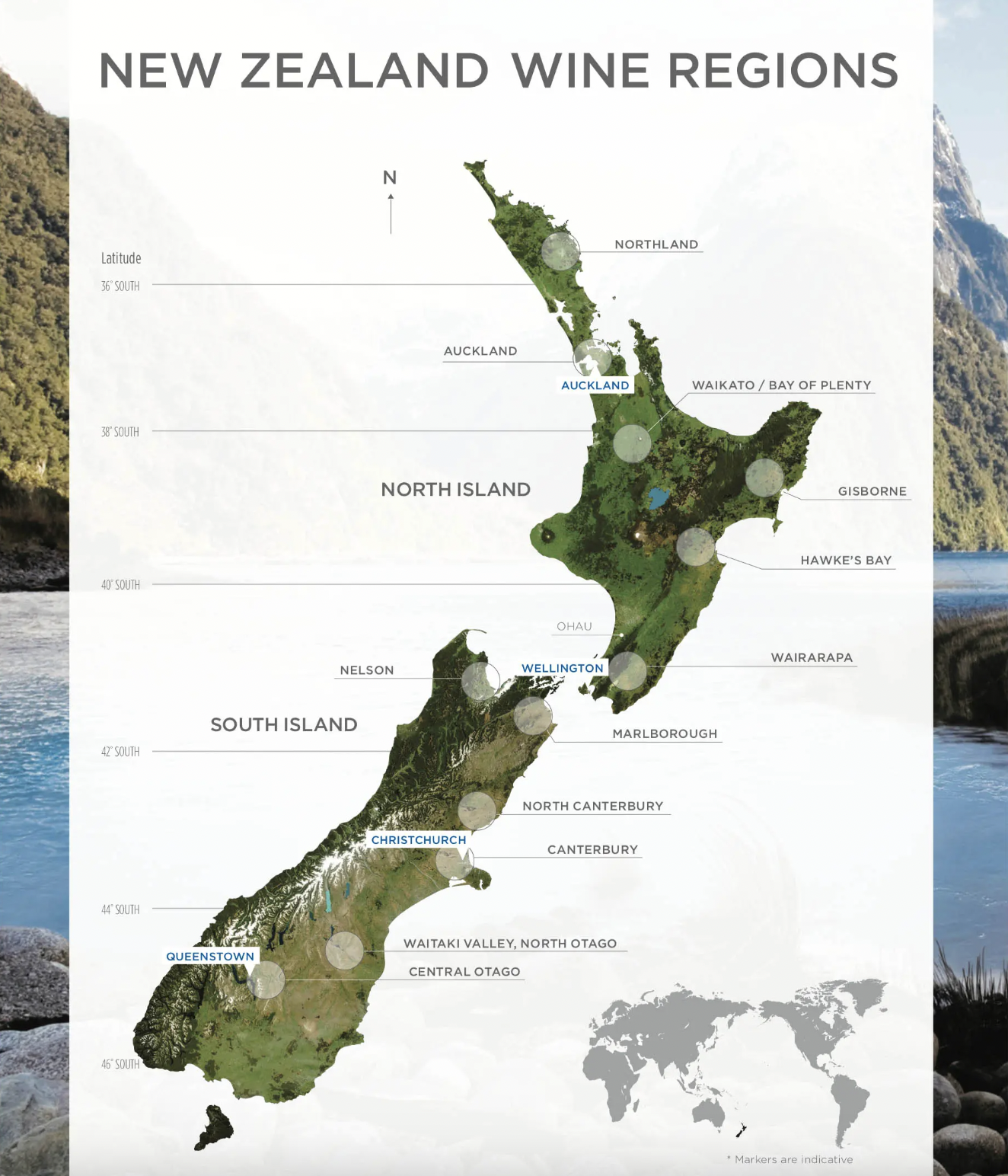
For a nation roughly the size of Colorado, New Zealand produces an outsized amount of wine. Around 105,000 acres are devoted to wine production. On the North and South islands, where most of the population lives, grapevines dot the dry riverbeds, valleys, lake edges and rolling hills pocked with limestone boulders. Vineyards span the subtropical Northland region to arid Central Otago, the most southerly commercial wine region in the world.
With no vineyard further than 80 miles from the ocean, New Zealand’s maritime climate, cool nights and long hours of sunshine mean many of its wines are refreshing, with bright fruit, heady aromatics and abundant acidity.
These characteristics apply to New Zealand’s unmistakable, gregarious Sauvignon Blanc. But New Zealand’s diverse climate, soil and topography also delivers muscular reds, long-lived Chardonnay, traditional-method sparkling wines, Riesling of all shapes and sizes, as well as myriad other aromatic styles.
New Zealand comprises 11 official wine regions, which received legal recognition in the form of geographical indications (GIs) in 2018. Small regions like Gisborne and Auckland in the North Island, and North Canterbury and Nelson in the South, are where some of the nation’s artisanal and creative winemaking takes place. Here, they grow relatively uncommon varieties with exciting promise like Chenin Blanc and Grüner Veltliner, as well as more traditional plantings like Sauvignon Blanc, Pinot Noir and Chardonnay.
The most prominent wine regions in New Zealand are Marlborough, Central Otago, Hawke’s Bay and Wairarapa.
More on the Featured Producers…
-
Villa Maria Winery has dominated NZ Wine Shows over the
last 10 years and comfortably wear the title of
New Zealand’s most-awarded winery.
They now have vineyards across NZ in Gisborne, Hawke’s Bay
and Marlborough and produce some of the top Single Vineyard
wines in the country.Villa Maria at every price point -
Bob Campbell MWVilla Maria has at least one wine in each of seven out
of the 11 Top Value Wines categories. Some years ago I
said to George Fistonich, the then owner of Villa Maria:
“Villa Maria has a formidable record of medals and trophies
at wine shows. How do you react to the criticism that you
are a ‘pot hunter’ who makes wines to win medals?”.
Sir George replied:“We work very hard to make the very best wines we can at
every price level. Good wines just happen to win medals.”
I can’t argue with that.… They continue to win medals in all price categories.
Quality is obviously still important to them but so is price.
The Real Review has 11 categories in its Top Value lists. Villa
Maria has at least one wine in seven out of those 11 categories.Pinot noir is a difficult grape variety to produce in large
quantities. There are only five wines in our Top Value pinot
noir list. The least expensive of those wines was Villa Maria
Private Bin Pinot Noir 2021 at NZD $19, their entry-level
pinot noir.Bob Campbell MW, Oct 17, 2023
-
The Critics on Felton Road
“This high-flying Central Otago producer earned consistently
top scores for most of its Pinot Noir, Chardonnay, and Riesling.
Bob Campbell, The Real Review“This is one of New Zealand’s most admired Pinot producers.”
Decanter“Felton Road is one of the legendary names in
New Zealand wine.
They’re probably the most famous of the Central Otago
wineries, making some highly regarded Pinot Noirs.”
Jamie Goode, Wineanorak.comAn inspiring producer of the highest calibre.
Dave Brookes, Halliday Wine Companion“The Prestigious Felton Road Winery is one of
the icons of Central Otago producers, and one of
the legendary names in New Zealand wine.”
wineNZ.com“The Felton Road vineyard was established by farmer Stuart Elms on a gentle slope at the southern end of Central Otago's Cromwell Basin back in the early 1990s, at a time when there was only a handful of other vineyards in the region. From the first vintage, in 1995 – all two hogsheads of pinot made by Grant Taylor at nearby Gibbston Valley winery – the vineyard showed promise, and the increasingly brilliant wines that emerged from Felton Road since helped build the region's reputation as a special spot, particularly for pinot. Elms' vineyard was purchased in 2000 by ex-pat Pom Nigel Greening, who had just planted his own Central Otago pinot block, Cornish Point. Greening then leased (and eventually bought) two other vineyards in the vicinity, converting to biodynamic farming methods across the four properties from 2002 onwards. Felton Road now farms 32 hectares across all its sites, and the core team of viticulturist Gareth King and winemaker Blair Walter have not only maintained quality but steadily improved it.”
Max Allen, AFR.com
Eighteen years after being bought by Englishman Nigel Greening, Felton Road has gate-crashed the top 10 in the Most Admired list after debuting at number 13 last year, putting it hot on the heels of Villa Maria for the honour of highest-ranking Kiwi producer... Felton Road has a zero-growth policy for environmental reasons and the prestigious Central Otago Pinot Noir for which it is best known – along with its Chardonnay and Riesling whites – is sold principally on allocation, with loyal trade customers first in line... Greening’s business ethics mean he resists artificially ramping up prices as the Felton Road reputation grows."
Drinks International
It is undeniable that Felton Road is one of the finest New World producers of pinot noir and a benchmark for those seeking the best that New Zealand wines have to offer. Founder Nigel Greening and winemaker Blair Walter have built the world-famous wine brand around fastidious site selection and viticulture (Demeter and Biogro certified biodynamic) and a range of wines that are not only beautifully crafted and compete effortlessly on the world stage, but speak so clearly of the intricacies of their Central Otago vineyards. The emphasis is on transparency of site and minimal intervention – great farming, gravity flow winery, wild yeasts, wild malo and no fining or filtration. An inspiring producer of the highest calibre
Dave Brookes, Halliday Wine Companion
Felton Road wines is located in Bannockburn, Central Otago in New Zealand, the most southerly wine growing region in the World. Here, vineyards are nestled into small macroclimates totally surrounded by high mountains, many of which are snowcapped all year round. Though the location is on the edge of sustainable viticulture these macroclimates consistently combine hot days, cool nights and long dry autumns. The latitude of 45 degrees south is similar to the Willamette Valley in Oregon and some of the finest wine regions of France. "Both of Felton Road's Pinot Noirs are breakthrough efforts in New Zealand and compete with the finest wines being made in California, Oregon and Burgundy's Cote D'Or. The Robert Parker, Wine Advocate
Beginning with meticulous site selection and vineyard design started in 1991, Felton Road's story is one of refusal to compromise. A strict 100% estate policy with fully organic and biodynamic viticulture (Demeter certified) ensures that our fruit arrives at the winery as pure as it can be, while our entire estate comes as close to true sustainability as is possible. A commitment to hands off winemaking: gravity flow, wild yeasts, wild malo, an avoidance of fining and filtration all help preserve the wine's expression of its terroir. The result is Riesling, Chardonnay and Pinot Noir which accurately express the authenticity and complexity of our unique vineyards.
Felton Road farms four properties totalling 32 ha in the Bannockburn sub-region of Central Otago. Block 2 is positioned on a gentle east facing slope immediately north of Block 3 on The Elms vineyard and was planted in 1992.
-
Greywacke (pronounced Greywacky) is the Marlborough label of the Judd family and the name of New Zealand’s most abundant bedrock. These understated grey river stones are found throughout Marlborough’s rivers and alluvial vineyard soils. Established in 2009, Greywacke is truly a family affair and while the company now exports its wines all over the world, the ethos is very much ‘keep it simple and hands-on’ with a small, dedicated team running the company from Greywacke HQ in the heart of Marlborough’s Omaka Valley. The fruit is sourced from mature vineyards in prime viticultural sites to optimise the potential afforded by Marlborough’s sunny South Pacific climate. All vineyards are sustainably managed with substantial and increasing proportions coming from organically farmed sites. Crop levels are restricted to enhance concentration of flavour and a long, cool growing season produces fruit with incredible varietal intensity and bright, natural acidity. Meticulous canopy management regimes are employed to provide sufficient fruit exposure to deliver ripeness of flavour, textural richness and optimum acid balance. Greywacke is accredited with AMW status (Appellation Marlborough Wine), ensuring provenance, authenticity and integrity. Each variety is grown and vinified using techniques aimed at achieving very specific wine styles, with a common objective of delivering concentration of flavour and a harmonious balance of texture and acidity. Minimalintervention winemaking is adopted to create wines with personality and individuality, aiming for subtle, ripe, delicious-drinking styles. Wild (indigenous) yeast fermentations are used extensively to incorporate savouriness to the flavour profile and build on the structure and intensity of mouthfeel. The Greywacke range is primarily based on two varieties, sauvignon blanc and pinot noir; the sauvignon being produced in two distinctly different styles. Limited releases of chardonnay, riesling and pinot gris complement the line-up. Kevin’s signature vineyard photographs provide the distinctive identity of the Greywacke labels.
-
Behind the Name:
An impromptu trek to a restaurant nestled high above the picturesque town of Queenstown in late 2004 was to provide the inspiration behind the name Nanny Goat Vineyard. Heading off to take in some breath-taking scenery, good food and of course some great Central Otago Pinot Noir, what was supposed to be a relaxing stroll quickly transformed into an arduous, unplanned deviation as the gentle terrain quickly transformed, leaving all concerned to navigate some rather perilous ground. A lighthearted comment likening the group to a herd of Nanny Goats struck a chord and would go on to become the inspiration behind the name.‘Nanny Goat Vineyard’ seemed to perfectly encapsulate our determination to succeed, adapt and thrive in the rugged and often extreme climates of Central Otago; much like the nimble and sure-footed wild goats of the region have done before us. From our inception and the inaugural release of our Pinot Noir in 2005, Nanny Goat Vineyard has strived to produce wines with elegance, concentration and balance whilst allowing each individual parcel of fruit to tell its unique story.
About the Winery:
Nestled within a timeless and sensual landscape, Nanny Goat Estate Vineyard sits between 270m and 290m above sea level spread across two ancient, North East facing terraces. This is a region of climatic extremes with typically very hot summers, short autumns and bitterly cold winter days. Challenging conditions for producing world-class cool climate Pinot Noir and Chardonnay.
Successive periods of glaciation and recession, followed by erosion by Mata Au / Clutha River have shaped the Nanny Goat Estate landscape by creating distinct terraces of alluvial soils that are pastiche of loess, gravel, schist and mineral quartz. Generations of farming and the associated cultivation of lucerne and other feed crops have added organic matter to the wind blowen loessial topsoil providing us with a nice balance between vine vigor and free draining attributes.
At latitude 45° South, New Zealand’s Central Otago is the most southerly wine region in the world. Vineyards are planted between 200m and 400m above sea level. Each vintage, we work with our Grower partners at Vela Vineyard, Legend Terrace Vineyard & Tankersley Vineyard to source Pinot Noir and Chardonnay from Pisa, Gibbston, Bannockburn & Queensberry.
The unique terroir of Central Otago produces wines of extraordinary intensity and distinction that show varietal and regional definition. The soils are free draining, with poor natural fertility. These challenging conditions for producing world-class cool climate wines are integral in our pursuit of magic.
-
Dog Point Vineyard is New Zealand's largest certified organic vineyard by Biogro NZ. Family owned and one of the oldest privately established vineyards, located on the hill slopes of the Southern Valleys of Marlborough, New Zealand.
They produce four wines including a sauvignon blanc, and three barrel fermented wines using natural (wild) yeasts including a sauvignon blanc fermented in older French oak barrels (Section 94), a chardonnay and a pinot noir.
Wines are vegan, vegetarian and gluten free reflecting our low interventionist ethos and a primary focus is producing wines of uncompromising quality that will cellar well.
Dog Point is one of the oldest privately established vineyards in Marlborough with first plantings in the late 1970s. The vineyard is centrally located at the confluence of the smaller Brancott and Omaka valleys. This location is widely considered to be a very desirable area for grape growing in the southern valleys of Marlborough.
The property is sensitively planted to sauvignon blanc, chardonnay and pinot noir grown under organic principles. On average our Sauvignon Blanc vines are 25 years old, however the oldest are well over 30 years of age. Section 94, our single vineyard, barrel fermented Sauvignon Blanc vines are 30 years old, and the average vine age for our Chardonnay is 30 years old, with the oldest vines being 40 years old. Our Pinot Noir vines date back to the early 1980s, making some of them approximately 40 years old.
THE NAME
The name Dog Point dates back to the earliest European settlement of Marlborough and the introduction of sheep to the district. These were the days where, due to a lack of fences, boundary riders used boundary keeping dogs to protect the local flocks of sheep. Shepherd's dogs sometimes became lost or wandered off, eventually breeding to form a marauding pack that attacked the same flocks they were meant to be protecting. Over time the settlers were able to remove these wild dogs and the area was named Dog Point. There is now a friendly "pack of dogs" that greet guests at the vineyard.
PAST, PRESENT & FUTURE
Ivan and Margaret Sutherland were among the earliest Marlborough wine industry pioneers who planted grapes in Marlborough in the late 1970s. While working at Cloudy Bay Vineyards, Ivan met James Healy, where the pair played an integral part of the evolution of the Cloudy Bay brand. Discovering they shared the same aspirations, Ivan & Margaret and James & Wendy returned to a more 'hands-on' approach launching the Dog Point label in 2004 using fruit from the2002 vintage. Today, with succession plans in place, the next generation of the Sutherland family are now running the day to day operations.
-
Escarpment, defined as a long, steep slope that lies at the end of a plateau, is our unique place within Martinborough. Big open skies stretch across the Wairarapa, and the ancient alluvial soils run deep beneath the land. There is natural balance here.
At Escarpment Winery, our purpose is to translate that balance into wines that reflect these special attributes, this special part of Aotearoa, New Zealand.
Over the last 35 years, we have created an expression of Martinborough Pinot Noir, Chardonnay, Pinot Blanc and Pinot Gris. Sculpted by Winemaker Tim Bourne and Viticulturist Rowan Hoskins from fruit entirely originating from Martinborough vineyards on the fabled alluvial gravels. We are focused on creating wines with an identifiable structure, complexity and fruit expression that reflect their distinctive sites and their regional Martinborough accent.
A Unique Sense of Place
Escarpment strives to produce wines that capture a unique sense of place. Our home vineyard on Te Muna Road is situated just minutes east of Martinborough village, with 24 hectares of distinctive alluvial gravel, terraced land stretches out along the banks of the Huangarua River. The soils of the vineyard are alluvial loams that were formed by the Huangarua River over 20,000 years ago. With very deep alluvial gravels now layered over the loams this composition ensures exceptional drainage, one of the key prerequisites for nurturing and producing premium quality, healthy grape vines.
Escarpment names their top Pinot Noirs after the vineyards from which the grapes were grown, rather than the grape variety. The Single Vineyard Kupe, Pahi, Te Rehua and Kiwa demonstrate this philosophy with distinctive elegance and character.
Escarpment sources fruit from our own vineyards as well as from growers around the Martinborough township. We are lucky enough to enjoy long term, established relationships with our growers that is reflected in the quality of our wines.
-
Rippon is a distinct parcel of land overlooking the Southern Alps on the western shores of Lake Wānaka.
The vineyard is farmed biodynamically and the land has been cared for by our family for four generations. Our wines are a true reflection of this piece of land.
Today, Rippon Estate continues to be run by the Mills family. It produces a highly lauded range of Pinot Noir from this magnificent landscape and its biodynamically-farmed vineyards. Breathtaking though it may be, every aspect – from the ground up – contributes to making the vineyard and its wines unique. Located on the 45th southern parallel, Central Otago is the most southerly winemaking region in the world, buffeted by the winds known as the 'roaring forties', which bring torrential rains to the western side of the island. However, Rippon is located on the eastern range of the Southern Alps, which protects it from the wind and the rain, with just enough precipitation falling to see it through its long, hot summers. Sitting at altitude helps mitigate the heat, with temperatures falling at night, locking in both flavour and freshness. Cool nights bring with them the danger of frost, especially in springtime when the vines are budding. But the nearby Lake Wanaka radiates warm air into the nearby vines, raising the temperature by as much as 4°, and the airflow created by the cascade on Mount Roy likewise helps prevents frost from settling. The soils themselves are largely schist, full of silica, quartz and mica. These produce wines that, like the rock itself, are multilayered, complex, lifted, precise and fine.
-
Martinborough | Aotearoa | New Zealand
In Te Reo Māori, Ata Rangi means “dawn sky” or “new beginning”. It is a name that honours our land and reflects the work we do here. Making wine is all about working in sync with the changing seasons and conditions on the land. We strive to craft wines that capture the essence of our place: Martinborough, Aotearoa-New Zealand. We are a small, family-owned organic winery with a reputation for pinot noir, located at the southern end of the North Island.
Ata Rangi was founded by Clive Paton in 1980. The first vines were planted on a small, stony sheep paddock at the edge of the Martinborough Village. Clive’s sister Alison bought an adjoining block soon after and in 1986 Clive’s partner Phyll Pattie bought a share in the business after moving from Marlborough where she had been working as a winemaker.
40 years on, we continue to work diligently to nurture Ata Rangi’s enviable reputation as one of the new world’s most respected pinot noir producers. Today, Alison Paton heads up day-to-day running of the business, with Helen Masters crafting the wines aided by the vital stewardship of vineyard manager Ian Ewart.
The Wine List
2023 Greywacke Wild Sauvignon Blanc
This is such a different beast from stereotypical Marlborough Sauvignon: a gamut of aromas from grassy to creamy via lime and ginger-like spice. Complex and inviting. The fragrance is complemented by the wine’s presence in the mouth: weighted, creamy yet fresh, almost a little savoury, which is perhaps the oak. The time on the lees shows in a roundness and richness despite the high acidity. A big yet elegant wine that needs to be sipped and savoured.’
17.5 Points, Julia Harding MW, JANCISROBINSON.COM
2023 Villa Maria Woven Sauvignon Blanc
Ripe, rich sauvignon blanc with tropical fruit and tree fruit flavours balanced by refreshing acidity. The wine has appealing intensity and a crisp, dry finish with impressive underlying power. It could surprise with a few years bottle age
95 Points - Bob Campbell MW, The Real Review
First Course
2020 Villa Maria Reserve Chardonnay
Champion Wine of Show, Hawkes Bay Wine Awards 2020
Rich, ripe and creamy chardonnay peach, nectarine fruit flavours plus nutty barrel-fermentation characters and a suggestion of struck-flint. A moderately intense and sophisticated style from a top vintage.
95 Points Bob Campbell, The Real Review (February 2022)
2022 Dog Point Chardonnay
Some enticing theatre popcorn, sparkler flint and lemon candies. Peach pit meets yellow plums and buttered crumpets... This also has the ability to be a bit of a chameleon, adapting well to fatty fried foods and sharp cheese equally well. A stellar vintage of their iconic chardonnay.
96 Points - Shanteh Wale, Halliday Wine Companion
2024 Felton Road Bannockburn Chardonnay
Taut, sleek chardonnay with a perfect balance of fruit sweetness and seductive, bright acidity driving a lengthy finish. Purity and power with citrus/lemon curd and oyster shell flavours. Delicious wine that’s hard to resist now but should develop well at least in the medium term.
97 Points - Bob Campbell MW, The Real Review
Second Course
2024 Nanny Goat Pinot Noir
A beautifully perfumed nose packed with wild red and black berry fruits, toasted brown cooking spices and lifted floral notes, layered over a subtle earthy background. The palate is juicy and lively up front, brimming with red cherry, plum, lightly roasted coffee beans and just a hint of sweet baking spice. A streak of fine acidity brightens the mid palate, blending seamlessly with fine powdery tannins to lift the palate towards a satisfying elegant finish.
Winemaker Tasting Notes
2022 Dog Point Pinot Noir
The '22 vintage wasn’t particularly easy, but the intent and meticulous attention of viticulturists shines bright in the best wines. The '22 is on fire, with cherry compote, blue plum skin and rhubarb stem. The selected 25% whole bunch adds just the right amount of sinewy, woodsy herbs backed by savoury potting clay and tree bark. Red lingonberries pop like caviar on the mid-palate and the staying power of graceful but astute tannins is why this wine will age like a dream. This is built for almost any medium rare meat you can throw at it – lamb, game or grass-fed beef. It's a wine for the very best crystal and only the best of friends for company. Stunning.
96 Points - Shanteh Wale, Halliday Wine Companion
2020 Escarpment Pinot Noir
This is the flagship Pinot Noir of this producer which means my expectations were pretty high - mainly because I have enjoyed this wine and style for many years - gosh it’s good. In fact it over delivers with a delightful bouquet of charm and power, a core fruit voice of dark cherry and baked strawberry, there’s a mix of barrel spices and floral charms, a carefully managed bouquet that is captivating and loaded with pinosity. Delicious on the palate driven by textures of fruit and oak, barrel toastiness and complex core of concentration without over doing any single attribute. A fine wine that impresses and delivers on style and charm, variety and power. Great drinking from 2024 through 2034.
95 Points “Outstanding” - Cameron Douglas, camdouglasms.com
Third Course
2024 Felton Road Bannockburn Pinot Noir
This wine makes my heart beat faster. It is delicate yet powerful, ethereal but wonderfully harmonious. I love its beautifully nuanced array of flavours that are displayed like the colours on a peacock’s tail and linger long after the wine has been swallowed. I have a cast-iron rule that prevents me from swallowing wine samples during tastings. I managed to stick to my guns. It wasn’t easy.
96 Points - Bob Campbell, The Real Review
2021 Rippon Mature Vine Pinot Noir
omplex with hint of smoky, savoury with wild mushroom, earthy and floral nuances. Small black fruits and rosehip. Good depth and density. Some oxidative notes? A bit edgier but also more accessible, good purity and a compact core of dense fruit. Very fine tannins build towards the back before becoming quite grainy. Savoury in style. Some brooding notes. Ethereal, chimeric.
94 Points - Stephen Wong, The Real Review
2021 Ata Rangi ‘Masters’ Pinot Noir
Equal 2nd Highest Pointed Pinot Noir from Martinborough, The Real Review
Highest Pointed of the 4 highly rated 2021 Vintage Ata Rangi Pinot Noirs, Erin Larkin, The Wine Advocate.
Light crimson. Strawberries and red peppers. Expressive with clearly exuberant fruit but not bombastic. It even smells crunchy. The palate is deeply flavoured with cola nut, black fruit, spice and sumac complexity. Less expressive than the nose, oak arrives mid-palate, contributing to a drying finish but with depth in reserve. Long, closed and very young with tight, cooler-climate acidity and linear, chalky tannins. Elegant and restrained at this stage, but with beautifully defined and detailed fruit which will reward cellaring.
96 Points, Ranked #4 of 32 2021 Pinot Noirs from Martinborough - Stephen Wong, The Real Review
Fourth Course
2020 Man O' War Dreadnought Syrah
Big, ripe and complex red with pleasing purity and impressive power that is clearly the product of a favourable vintage. It has drinkability although it is a wine that will certainly repay keeping.
96 Points - Bob Campbell, The Real Review
2019 Villa Maria Ngakirikiri Cabernet Sauvignon
The 2019 Villa Maria Ngakirikiri Cabernet Sauvignon has earned its place in The World of Fine Wine’s handpicked collection.
Villa Maria’s icon wine, produced only in exceptional vintages. Always Cabernet Sauvignon-dominant, the 2019 also has 5% Merlot, and is aged for 20 months in barrel, 65% new. Ngakirikiri in Māori refers to the unique soils of the Gimblett Gravels, whose diurnal temperature range, low-yielding vines and long growing season give ageworthy, ripe, aromatic reds. Christine Marsiglio MW: The nose is brooding, intense and aromatic – a difficult feat to achieve. Screams Cabernet, yet it’s both elegant and powerful. Top stuff. Freddy Bulmer: Ample intensity on the nose, the palate spicy and full with sundried tomato, basil, cassis and Morello cherry. Pepper spice on the finish, with notes of iron. Huge potential. Roger Jones: Dark, brooding, complex fruit with cedar, violet, refined mocha and meat juices. Seamless, with hints of mint and tomato stalk.
97 Points - Decanter, Christine Marsiglio MW, Freddy Bulmer, Roger Jones (at Decanter Tasting Suite, London, 06 Jun 2023)
Fifth Course